DW director urges EU regulations to protect news funding from AI
Moldova is on the frontline of information warfare, making it one of the countries most exposed to Russian propaganda, particularly online. This persistent stream of disinformation erodes the public's ability to distinguish fact from manipulation.
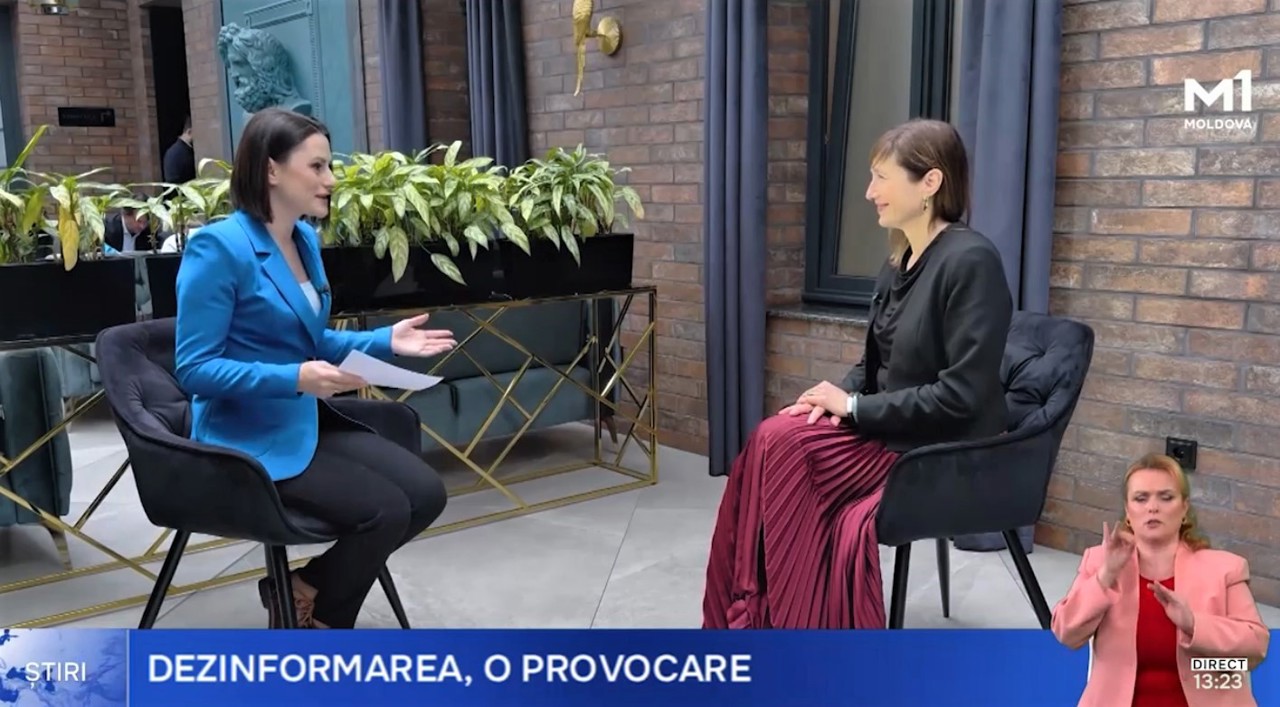
In an interview with Moldova's public broadcaster, Moldova 1, Barbara Massing, the Director General of Germany's international public broadcaster, Deutsche Welle (DW), stressed the crucial role of media literacy in countering manipulation and the necessity of sustaining quality journalism to consolidate democracy.
"What we observe from the Russian Federation and many other authoritarian regimes is their attempt to manipulate through fear and sow uncertainty among the population," Massing stated.
"Fortunately, after 80 years in Western Europe and 35 years in Eastern Europe, we have democracies, open and liberal societies. This represents a force that cannot be neglected."
The DW Director emphasized that the press must provide impartial information as a factual counterpoint to manipulative content, specifically to rebalance polarizing narratives.
"This challenge isn't unique to Moldova; it affects other European countries like the Czech Republic, Romania, and Serbia," the journalist noted. "Even in France, a far-right party with authoritarian tendencies is gaining influence."
"That is why it is extremely important not to rely only on narratives that reinforce authoritarian forces. We must offer impartial, fact-based information so people can see the truth and have the freedom to choose. Liberal democracies represent a vital choice."
Massing confirmed that DW has increased its social media presence to deliver accurate information where the audience is.
"We continue to air our broadcasts on Moldova 1 and run other TV projects. Additionally, we have expanded significantly on TikTok," she said. "We established a young team right here in Moldova with journalists dedicated to producing content for that platform."
"We know that in many countries, young people get their information almost exclusively from social media and TikTok. We must be present there, even amid heavy propaganda, to offer factual content and reinforce reliable news. On the other hand, media literacy is extremely important."
Massing is confident that quality journalism has a future "because people, in the end, need the truth."
"Of course, influencers and news explainers are important because people inherently trust other people," she observed. "We want to strengthen the public-facing personalities people trust. But we must also ensure that quality media has a solid financial foundation to pay for quality journalism, which is inherently expensive."
The DW Director cited Germany's public media model, structured with mechanisms for independence and civic oversight.
"In Germany, public broadcasters are funded through public contributions, typically license fees," she explained. "However, our accountability for organization and standards is overseen by a Program Council, which monitors content, and an Administrative Council, which handles strategy and investments. Both bodies govern our editorial direction."
Finally, Massing highlighted the urgency of promoting clear European Union regulations to protect the visibility and funding of the press in the AI era.
"Clearer EU-level rules are necessary to improve the visibility of quality media," she stressed. "This is not just a visibility issue; it's a financial one."
"If people only rely on AI-generated summaries, they stop visiting news websites and reading the original content. The quality press then loses the income needed to pay journalists."
"Journalism costs money for research, fact-checking, and real work. If we fail to ensure quality press gets its fair share for its product, its financial basis collapses," Massing warned. "We are working on multiple aspects to ensure journalism's future, as it is essential for democracy: only by knowing the facts can you make informed decisions to protect democracy."
Translation by Iurie Tataru