EU strengthens its eastern flank, explicitly including Moldova in interconnection plans
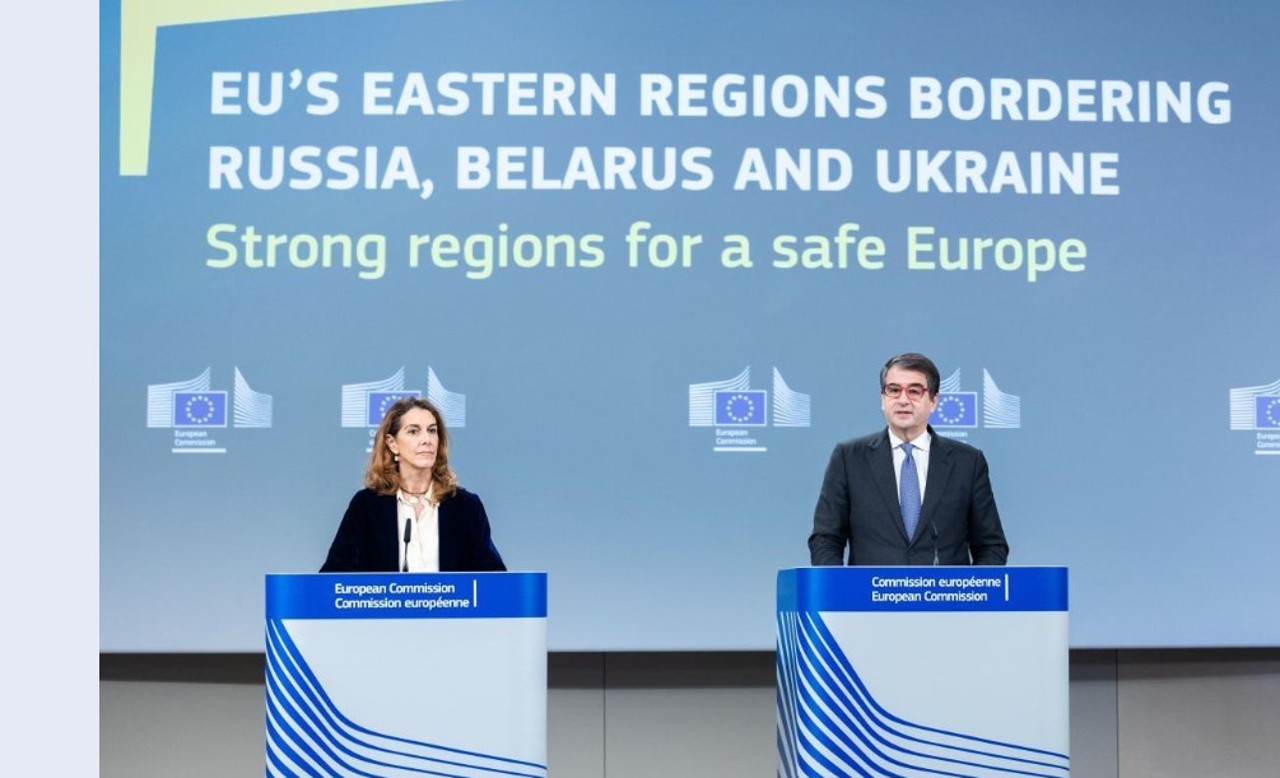
The European Commission has implemented a comprehensive strategy aimed at enhancing the resilience and prosperity of EU regions that border Russia, Belarus, and Ukraine, in response to the increasing pressures caused by the war in Ukraine. Although the Republic of Moldova is not an EU member state, it is explicitly included in several key aspects of this strategy. These components range from improving connectivity and transportation infrastructure to combating disinformation and facilitating integration into the European internal market.
The document, published on Wednesday, 18 February by the Commission, identifies nine EU Member States whose border regions have been severely affected by Russia’s war of aggression: Finland, Estonia, Latvia, Lithuania, Poland, Slovakia, Hungary, Romania and Bulgaria.
These regions face a variety of unprecedented challenges: hybrid warfare, politically instrumentalised migration, severe economic and trade disruptions, as well as an accelerated demographic decline.
The strategy proposes concrete measures in five priority areas – security and resilience, regional economic growth and prosperity, building on local strengths, connectivity and people – and foresees the establishment of an annual high-level political dialogue, the first of which will take place on 26 February 2026, when the declaration launching the EastInvest Facility will be signed.
Military security and civil resilience
One of the most robust pillars of the document is the one dedicated to security. The Commission announces the development of collective defence instruments at European level: Eastern Flank Watch – a mechanism for monitoring the security situation on the eastern flank, the European Drone Defence Initiative, the European Air Shield and the European Space Shield.
At the same time, a network of practitioners will be created to strengthen civil preparedness and cross-border cooperation on resilience.
On the economic front, the Commission proposes the EastInvest facility, a financing mechanism that will bring together the European Investment Bank Group, other international financial institutions, and national promotional banks to improve access to loans and advice in the affected regions.
According to the European Executive, cooperation with the World Bank under the “Catching-up Regions” program aims to stimulate economic development in the most vulnerable areas.
Moldova, integrated into the EU transport and logistics networks
Although it is a candidate country and not a member state, the Republic of Moldova plays a prominent role in the strategy, particularly in connectivity. The document explicitly mentions extending the Trans-European Transport Corridors (TEN-T) to Ukraine and Moldova as part of a broader effort to integrate the eastern flank into the European internal market for transport and logistics.
The Commission announces that it will intensify cooperation on network infrastructure involving national administrations in line with the European Transport Corridors, including extensions to Ukraine and the Republic of Moldova.
At the same time, the strategy provides explicit support for integrating railway systems in the eastern border regions with EU networks, both within the TEN-T and the Connecting Europe Facility (CEF), with the dual objectives of improving military mobility and creating additional economic opportunities.
The Baltic-Black Sea-Aegean Corridor is described as a strategic extension of the TEN-T to Ukraine and the Republic of Moldova, supporting their gradual integration into the Union's transport and logistics system. The Port of Constanta plays a nodal role in this architecture, serving as an essential access point for Moldovan goods.
The strategy reaffirms the importance of the EU-Ukraine Solidarity Corridors, launched at the start of the Russian invasion in 2022, which have enabled trade flows to continue when traditional export routes were blocked. Although the mechanism primarily targets Ukraine, Moldova has indirectly benefited from these corridors, as a significant share of the transit of Ukrainian and Moldovan goods passes through the country's territory and infrastructure.
The Commission states that almost €2 billion has been allocated from cohesion funds and the CEF Transport to strengthen cross-border road and rail connectivity, including for navigability on the Danube and capacity at key border crossings and ports. These investments are also directly relevant to Chisinau, which depends on the same transit routes to access Western markets.
Fighting against disinformation – a chapter in which the Republic of Moldova has a say
Another area in which the Republic of Moldova appears to be nominated in the strategy is information resilience and combating disinformation. The document announces the establishment of a new center of the European Digital Media Observatory (EDMO) – called FACT (Fighting Against Conspiracies and Trolls) – created specifically to support Ukraine and the Republic of Moldova, along with the Member States most exposed to information manipulation of Russian origin.
This decision reflects the Commission’s explicit recognition of Chisinau’s particular vulnerability to Russian influence operations, from the presidential elections and constitutional referendum in 2024, to the parliamentary elections in 2025. The FACT center will join the other mechanisms of the recently adopted European Democracy Shield, through which the EU aims to strengthen the collective capacity to respond to interference campaigns in the information space.
The strategy also addresses the restructuring of Interreg programmes after the suspension of cooperation with Russia and Belarus in 2022. The €150 million reallocated from the suspended programmes went partly to external cooperation programmes with Ukraine and the Republic of Moldova, signaling a deliberate reorientation of European territorial cooperation instruments towards partners in the Eastern Neighbourhood.
Furthermore, in the proposal for the future multiannual financial framework 2028-2034, the Commission foresees that future transnational cooperation spaces will be able to dedicate part of their funding to cooperation with Ukraine and our country.
This opens up new prospects for the participation of the Republic of Moldova in joint regional development projects financed from the EU budget, even before formal accession.