Moldova tax reform yields record returns from freelancers

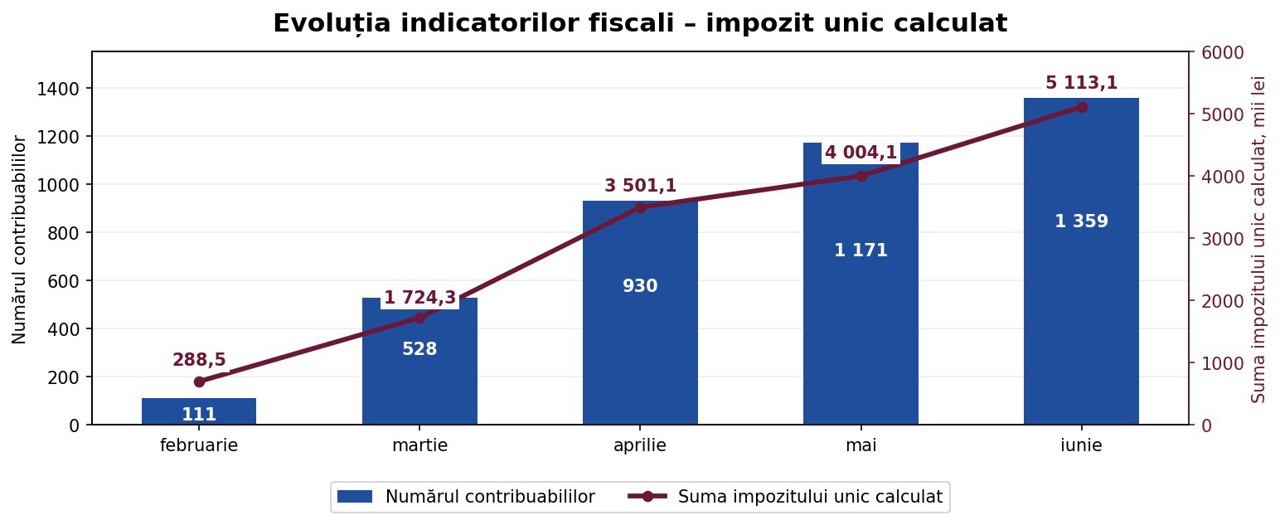
The State Tax Service of the Republic of Moldova confirmed an acceleration in fiscal performance driven by the newly introduced simplified tax regime for freelancers. Independent entrepreneurs and freelancers declared revenues of €1.84 million (approx. 36.11 million MDL) in May 2026 alone. This represents a substantial 34.2% increase compared to April figures.
Consequently, the calculated single tax collected from this category climbed to €276,500 (approx. 5.42 million MDL). Tax authorities generated nearly 3,000 payment notices for May, with the strict settlement deadline set for June 25.
Accelerated trajectory of the simplified framework
May marks the second consecutive month of rapid growth for this segment. In April, the same category of taxpayers reported revenues of 1.37 million EUR, generating 205,600 EUR in taxes. This represented a 15.3% increase over March.
In parallel, the total number of registered independent entrepreneurs rose from 2,560 on May 11 to 2,844 by June 10. Cumulative single tax revenues have reached 489,300 EUR since the regime launched on January 1, 2026.
Eradicating red tape to meet European standards
The framework allows individuals across approximately 40 service sectors—including IT consulting, software programming, graphic design, translation, and photography—to operate legally. Beneficiaries operate without setting up a corporate entity, bypassing traditional bookkeeping and complex tax filing.
Contributors pay a single 15% flat tax on income, which consolidates personal income tax, state social insurance, and mandatory health insurance premiums. However, to maintain fiscal progressivity, a 35% tax rate applies to any annual income exceeding the €61,200 threshold.
For Chisinau, the mechanism achieves a dual strategic goal: broadening the tax base while extending robust social safety nets to a traditionally informal workforce. The single tax collected is redistributed directly to local budgets (31.3%), the state social insurance budget (53.3%), and the mandatory health insurance fund (15.4%).
This early fiscal evolution aligns with Moldova's broader strategic push toward digitalization and deregulation. These structural reforms remain central to the economic commitments assumed by Chisinau in its ongoing European Union accession process.
Translation by Iurie Tataru