Moldovan journalists face intimidation; solidarity and law enforcement are vital
The Republic of Moldova is witnessing a worrying rise in attacks against journalists. Although legal safeguards are in place, Petru Macovei, director of the Association of Independent Press (API), says they are not being adequately enforced. He stresses that media solidarity and public pressure are essential to fighting impunity.
API documented 97 cases in 2025—the highest number of attacks against journalists since the monitoring of this phenomenon began in 2017. The majority—approximately 80%—occurred online. These incidents were aimed at intimidating journalists, including through threats to their lives and physical well-being.
Female journalists are the most vulnerable; some have received death threats on social media. Furthermore, in 12 instances, journalists were subjected to physical assault—primarily during protests organized by the Șor group and its affiliated parties. Reporters covering these demonstrations were shoved, struck with various objects, and doused with water. The issue lies not only in the number of attacks but also in the lack of sanctions for the perpetrators.
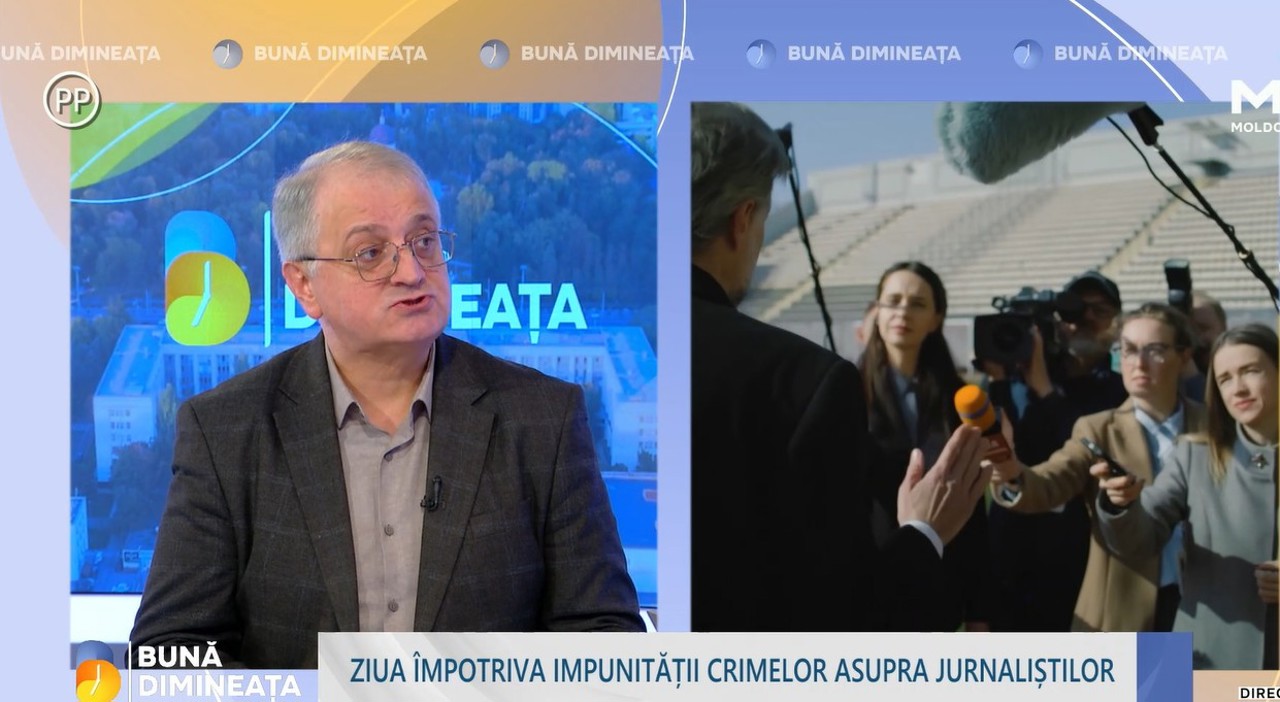
"No such incident should go without consequences. Every case of this nature must, first and foremost, be brought to the police's attention and pursued. Pressure must be applied to ensure that these actions are met with sanctions," stated Petru Macovei during the program "Bună Dimineața" on Moldova 1 TV.
The API director believes that the absence of consequences for those who threaten or assault journalists encourages the repetition of such behavior. He cited the case of a female journalist who received death threats on social media from a Moldovan citizen living abroad. The individual was detained at the airport upon returning to the Republic of Moldova two years after the incident; however, the journalist chose to forgive him. "I do not believe this is exactly the right decision. After all, I repeat: if we continue to tolerate such situations, things will not improve," said Macovei.
Another issue is the behavior of certain politicians who verbally attack journalists, label them, or attempt to discredit their work whenever published reports cast them in a negative light or are otherwise unfavorable to them. According to Macovei, such attitudes contribute to the normalization of aggression and encourage others to resort to intimidation. The API director advocates solidarity among newsrooms and raising awareness of journalism's role in society.
"Any attack against a journalist must be viewed as an attack against society itself. After all, it is journalists who bring the truth to light—they are the ones who conduct investigations, including into acts of corruption—and any attempts at intimidation must be sanctioned," stated Petru Macovei.
Forms of intimidation include SLAPP-style actions, in which politicians or businesspeople resort to coordinated legal proceedings to pressure journalists and discourage them from publishing inconvenient information.
"In the Republic of Moldova, we have several such cases, involving politicians and businesspeople who attempt to intimidate journalists by filing numerous claims in various courts, with the goal of silencing them," explained Petru Macovei.
Mechanisms exist, but law enforcement remains inadequate
The Ministry of Culture, through its Media Policy Development Directorate, has drafted a plan to combat SLAPP-style actions, and a working group—which includes representatives from the journalistic community—is preparing measures to curb this phenomenon. Furthermore, the legislation introduced provisions on the "insulting or affronting of a journalist" last year. Nevertheless, the director of the API (Association of the Independent Press) notes that the primary issue lies in the enforcement of existing regulations.
"Our legislation is not in bad shape; however, implementation is a greater challenge. Therefore, it is crucial to strengthen this aspect. I repeat: solidarity among journalists is vital. Initiatives aimed at explaining the importance of protecting the journalistic profession are equally essential," emphasized Petru Macovei.
He also underscored the importance of maintaining constant public pressure on politicians to compel them to cease their attacks on, and labeling of, journalists. Furthermore, law enforcement institutions need to respond more promptly, and personnel who intervene during protests need better training. According to Macovei, in some instances, police officers failed to react appropriately because they lacked the necessary knowledge and skills to handle such situations.
Recently, the API has filed several complaints with the police and the prosecutor's office, after determining that certain threats made against journalists constituted criminal offences. Macovei argues that authorities should not merely respond to formal complaints but should also take proactive action—initiating investigations on their own initiative—whenever such abuses are identified.
Statistics indicate that investigative journalists and those working in small teams face greater risks than their counterparts who have the backing of large media organizations. In these circumstances, mutual support and professional solidarity become even more important.
Media in the Transnistrian region and Gagauzia: vulnerable
The situation is particularly difficult in the Transnistrian region, where control is exercised by the pro-Russian separatist administration in Tiraspol. According to Macovei, journalists operating on the left bank of the Nistru are effectively silenced. The situation is no better in the Autonomous Territorial Unit of Gagauzia.
“In the Transnistrian region, the situation is completely beyond control; fellow journalists working there are effectively silenced, as all media outlets and public communication platforms are controlled by the special services—the KGB—and the local administration. As for the Gagauz autonomy, the situation is indeed poor, and reports indicate that most attacks have originated from local politicians,” Macovei said.
The API director noted that, in previous years, local politicians have been responsible for inciting hatred and violence, including against journalists. He expressed hope that the situation would change following the elections on November 15, while also pointing out that journalists in Gagauzia have not always received solidarity or support from their colleagues in Chișinău when faced with abuse.
“We must strive to ensure that traditional journalism—grounded in truth and professional ethics—once again serves as a reliable source of information for the public. Trust is our primary shield,” stated the API executive director. The protection of journalists will be one of the topics discussed at the 2026 Media Forum, scheduled for December 7 and 8. According to the director of the API, efforts to combat intimidation must be accompanied by the strengthening of public trust in the press. Adherence to ethical standards and the quality of journalistic content are the primary mechanisms through which journalists can defend their credibility.