Moldova needs over 11 billion euros for water and sewage systems, with a shortage of engineers posing a greater challenge
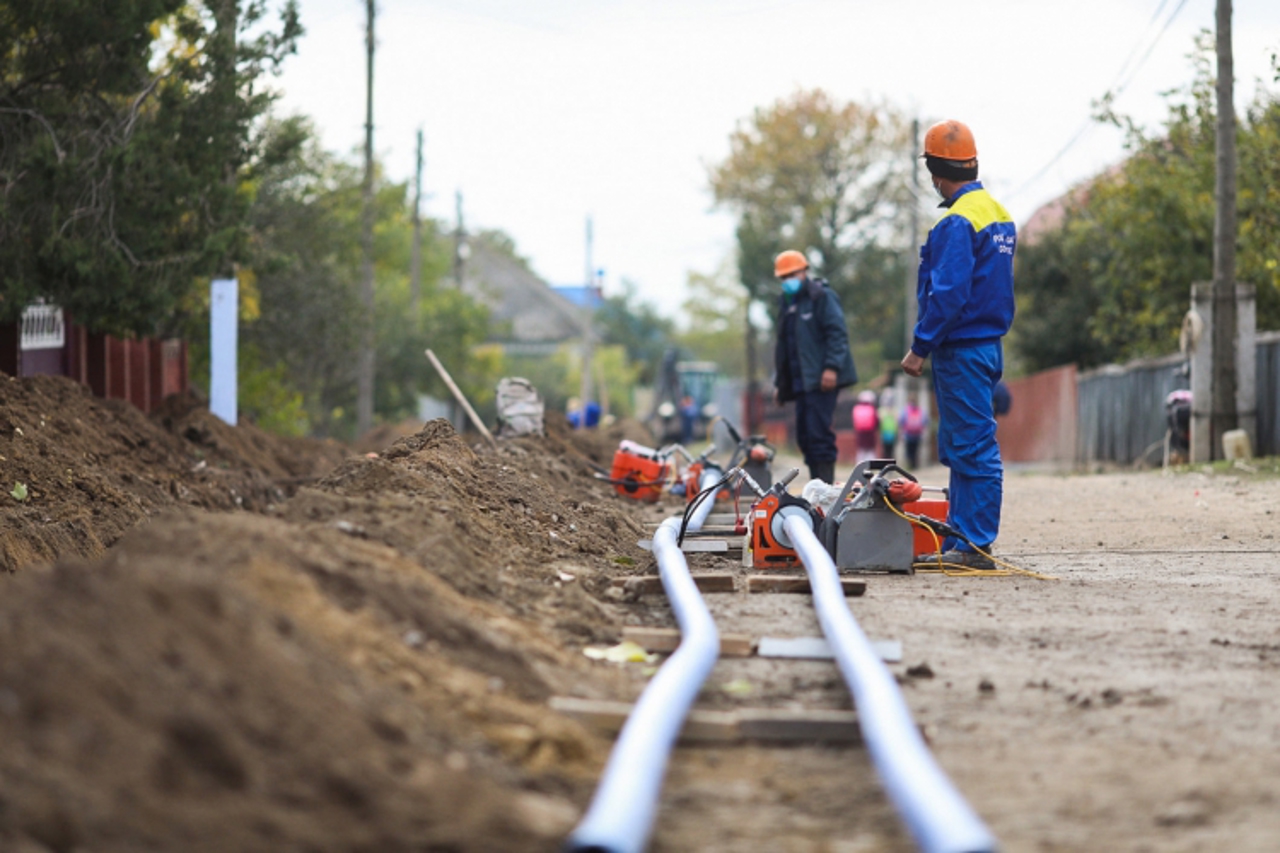
The Republic of Moldova would need more than 11 billion euros to ensure all localities have access to drinking water, sewerage systems, and modern wastewater treatment plants. Of this amount, approximately 4.4 billion euros would be required for water supply and over 6.7 billion euros for sewerage and wastewater treatment.
However, even if funding were available, the country would face another major challenge: a shortage of specialists to design, build, and manage the infrastructure. This is the view of Ghenadie Ivașcenco, an economist, local and regional development expert, and founder and lead consultant at EUROPOLIS International.
According to the economist, the investment requirement is estimated in the feasibility study for the "Water and Sanitation" section of the National Spatial Planning Plan—a document developed with the support of the World Bank and the Austrian Development Agency (ADA). This figure represents the value of investments needed to extend services to all localities—including through the development of regional systems—rather than funds that are currently available.
Ghenadie Ivascenco, who—along with the EUROPOLIS team—participated in drafting the National Water and Sanitation Program 2026–2030, notes that the challenges go beyond simply securing funding. The Republic of Moldova faces the risk of an engineer shortage, infrastructure built to outdated standards, and an inability to ensure the efficient operation of wastewater treatment plants.
"As difficult as it may be to attract these billions, it might prove even harder to invest them efficiently," he warns in an analysis published on Facebook.
No specialized cohorts of water and sewerage engineers have been formed for six years
One of the most significant vulnerabilities is the lack of specialized personnel. According to Ivascenco, the Technical University of Moldova has not formed dedicated cohorts for the water and sewerage specialization for the past six years, due to an insufficient number of applicants.
Furthermore, there are reportedly only three faculty members left in the country who hold the academic credentials required to teach specialized subjects in this field—two of whom have already passed the retirement age.
"Who will design, build, and operate this 11-billion-euro infrastructure? The funds could arrive tomorrow, but it takes years to train engineers," the expert points out.
This issue is all the more critical because infrastructure investment does not end with the construction of a network or a wastewater treatment plant. Such facilities must be properly designed, operated, and maintained over the long term—a process that requires qualified personnel.
Soviet-era standards and projects that may cost more than necessary
Another issue concerns the technical standards used in infrastructure design. According to Ivascenco, the Republic of Moldova still partially applies Soviet-era regulations from the 1970s and 1980s; in some cases, these standards overestimate consumption levels, leading to inflated costs.
Consequently, there is a risk of building oversized systems that are both more expensive and more difficult to operate. At the same time, regulations lag behind various modern solutions—options that could be more cost-effective, particularly for smaller localities.
"How much could we save from that 11-billion-euro total if we updated these regulations first?" the expert asks.
Over a third of water and sanitation operators are running at a loss
Even when infrastructure is built with external funding, its ongoing operation depends on the service providers' financial capacity. According to an analysis presented by Ivascenco, more than a third of licensed water and sanitation operators are running at a loss, and eight of them are currently insolvent. Thus, there is a risk that the Republic of Moldova might build modern wastewater treatment plants using European grants, only to find itself subsequently lacking the resources required to operate them.
"We can build modern wastewater treatment plants using European grants, but operating them requires financially viable operators," he explains.
In this context, Ivascenco emphasizes the importance of regionalizing services, implementing professional management, and establishing sustainable tariffs that allow operators to cover their operating and maintenance costs.
Investment requirements have increased compared to 2014 estimates
For comparison, the strategy developed in 2014 estimated a requirement of approximately two billion euros for the entire water and sewerage sector. The new estimate exceeds 11 billion euros.
This difference is attributed to inflation and stricter requirements for water quality and wastewater treatment, in the context of the Republic of Moldova’s alignment with European directives.
The feasibility study for the "Water and Sanitation" section of the National Spatial Planning Plan was developed with the support of the World Bank and the Austrian Development Agency (ADA). A diagnostic analysis of the sector was conducted in November 2026.
"We must not remain passive, waiting for billions to arrive from the EU"
Ghenadie Ivascenco believes that some of the sector's problems can be addressed even before large-scale investments are secured. Updating technical standards, training a new generation of engineers and educators, and strengthening regional operators would require millions of euros—not billions. "The good news is that we already know what needs to be done. And we shouldn't just sit idly by, waiting for the 'billions from the EU' to arrive", the specialist says.
He believes that the Republic of Moldova can invest in preparing the sector well in advance, so that future funding can be utilized more efficiently.
"Today, Moldova has the opportunity to invest a relatively small amount so that, tomorrow, it may gain much more from every billion invested," concludes Ghenadie Ivascenco.
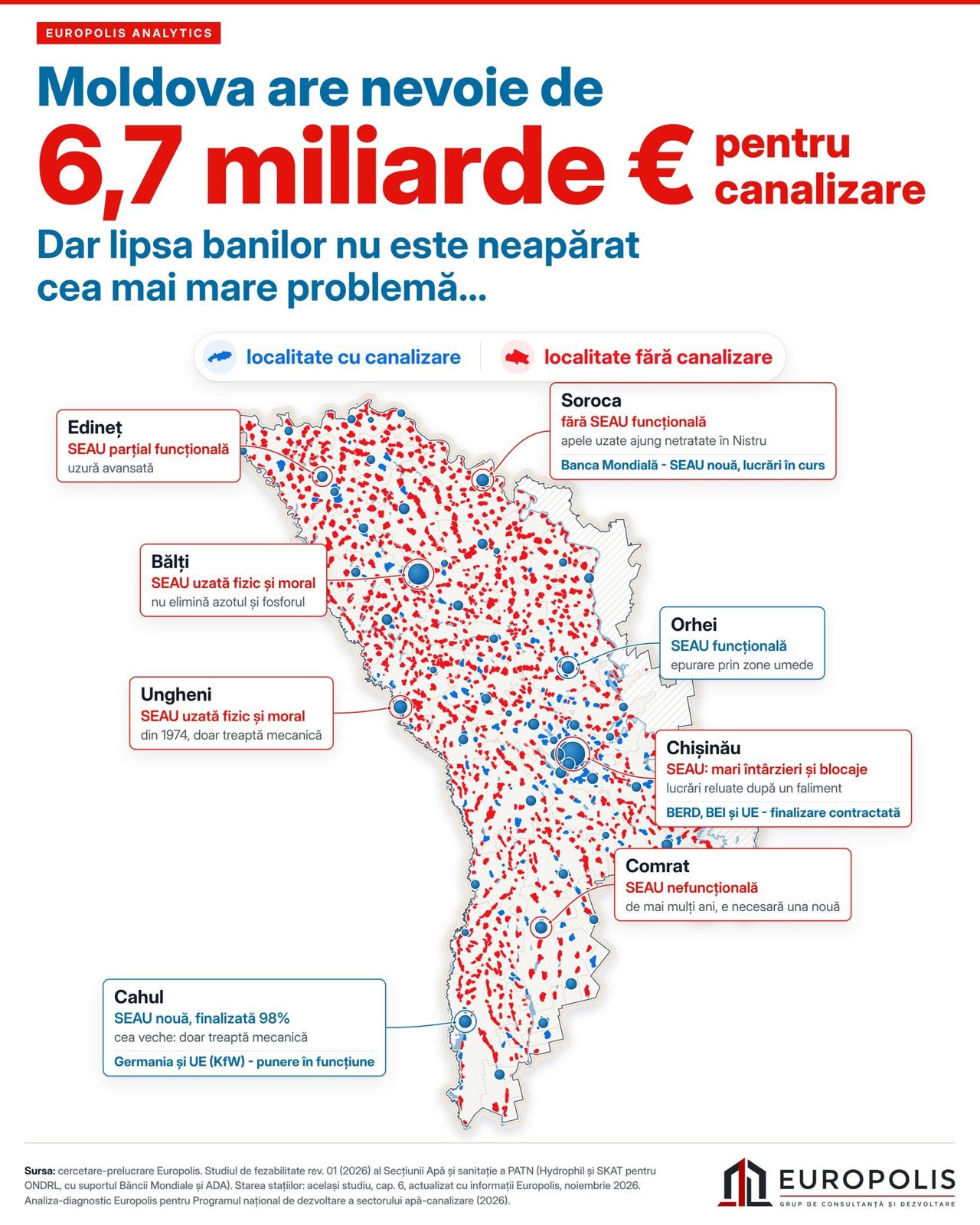
According to data from the National Bureau of Statistics for 2025, 69.1% of localities in the Republic of Moldova had access to public water supply systems, an increase from 66.8% in 2024. In contrast, only 10.7% of localities were connected to public sewerage systems. The total length of water distribution networks reached 22,400 kilometers, while that of sewerage networks reached 5,900 kilometers.
Concurrently, the first edition of the "European Village" National Program saw the completion of 153 projects focused on the construction and expansion of water supply and sewerage systems. Another 243 projects are currently being implemented under the second edition. For the 2026–2030 period, the cost of the measures outlined in the program is estimated at approximately 598 million lei.
The Growth Plan for Moldova includes a €229 million project to expand water supply networks in the northern and southern regions of the country, as well as in the Gagauzia Autonomous Territorial Unit (ATU). The project will provide access to safe drinking water for approximately 700,000 residents across ten districts. It entails the construction of roughly 655 kilometers of pipelines, two water intake facilities, two treatment plants, and five pumping stations. Work is scheduled to begin in 2028, with project completion expected by the third quarter of 2030.